A language-conditioned manipulation policy that repurposes a pretrained
geometric foundation model as one shared backbone for perception,
future prediction, and action; more accurate, more robust, faster, and lighter
than foundation-model-scale baselines.
GAM reuses a geometric foundation model as the policy backbone, predicting future geometry and actions in one efficient pass.
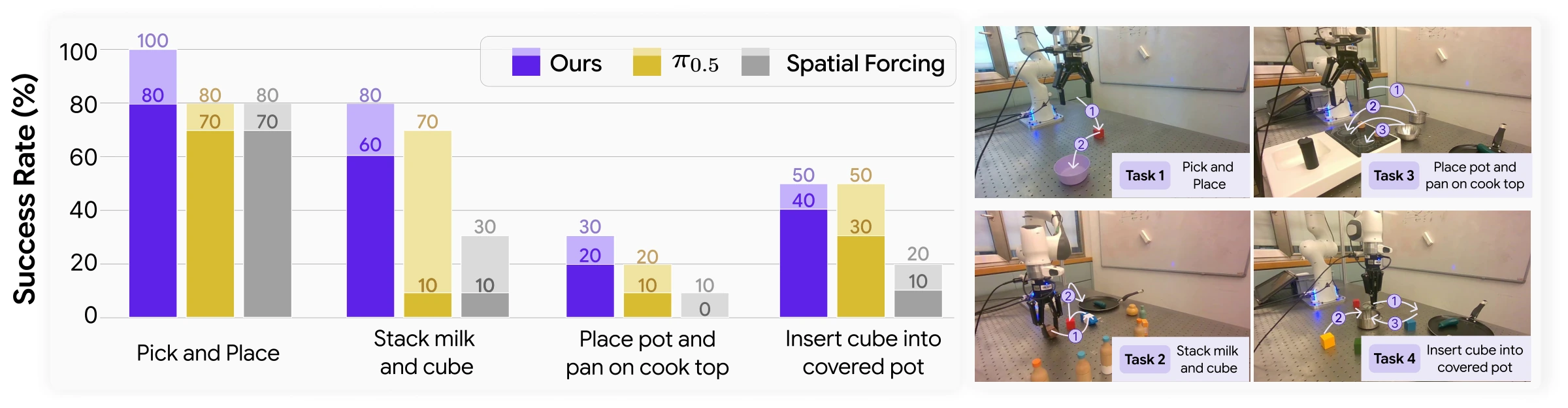
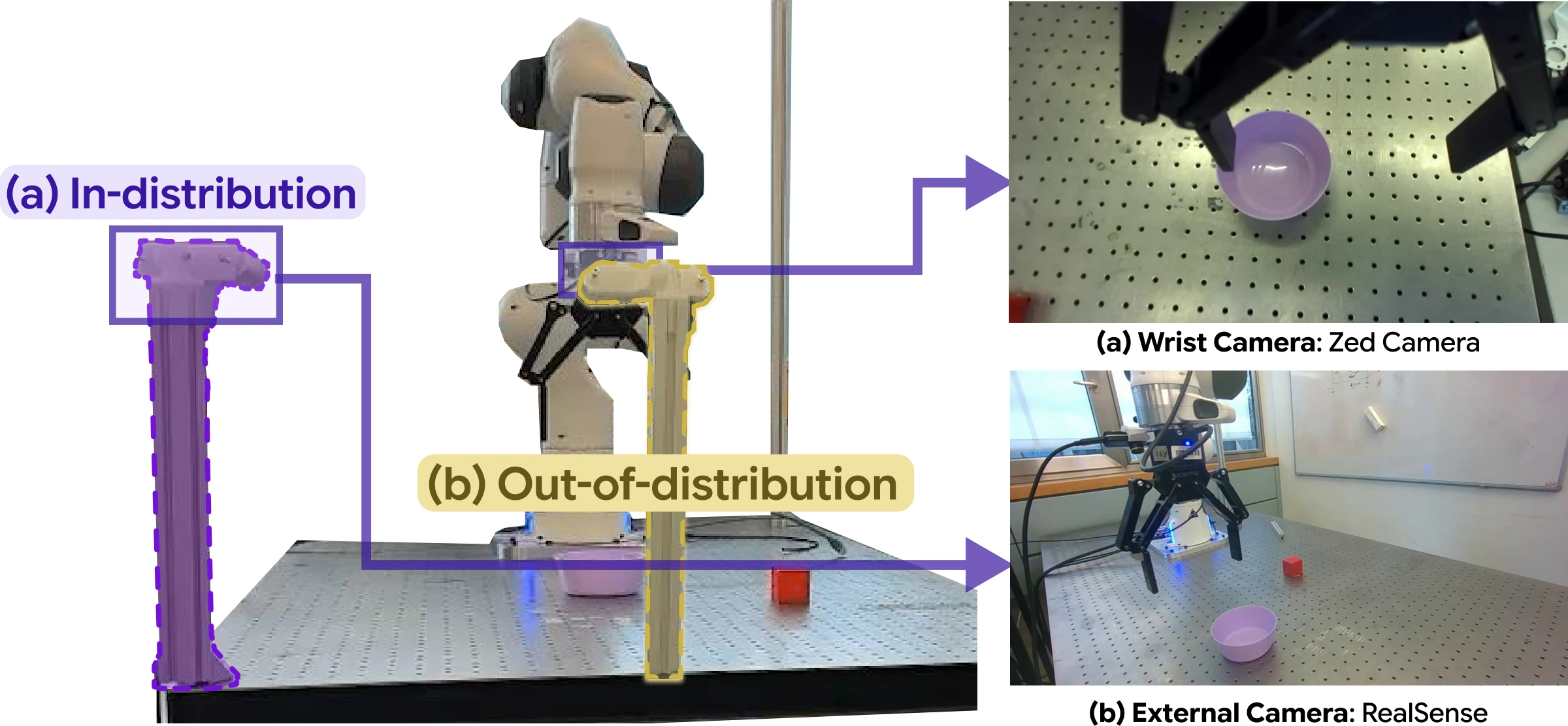
Real-robot comparison of GAM against π0.5 and Spatial Forcing across four manipulation
tasks, in nominal (ID) and camera-perturbed out-of-distribution (OOD) settings.
85.5%
LIBERO-Plus success
best overall under perturbations
+9.7%p
Camera robustness
over the next-best baseline
6.9 ms
Inference latency
≈145 Hz · up to 55× faster
1.4B
Total parameters
vs 2–8.5B for baselines
Overview
Geometry is the missing substrate of robot policies.
Generalist robot policies must follow user instructions while reasoning about how objects, cameras, and
robot actions interact in the 3D physical world. Recent vision-language-action models and video
world-action models inherit strong semantic or temporal priors from large-scale foundation models, but
they still operate primarily on 2D image frames or 2D-derived latent spaces, leaving the geometry required
for contact-rich manipulation implicit.
We propose Geometric Action Model (GAM), a language-conditioned manipulation policy that directly
repurposes a pretrained Geometric Foundation Model (GFM) as a shared substrate for perception,
temporal prediction, and action decoding. GAM splits the GFM at an intermediate layer: the shallow layers
serve as an observation encoder, while a causal future predictor inserted at the split layer forecasts
future latent tokens conditioned on language, proprioception, and action history. The predicted future
tokens are then routed through the remaining GFM blocks, allowing a single backbone to produce both
future geometry and actions. On a broad suite of simulation and real-robot benchmarks, GAM is
more accurate, more robust, faster, and lighter than current foundation-model-scale baselines.
Method
One geometric backbone for perception, prediction, and action
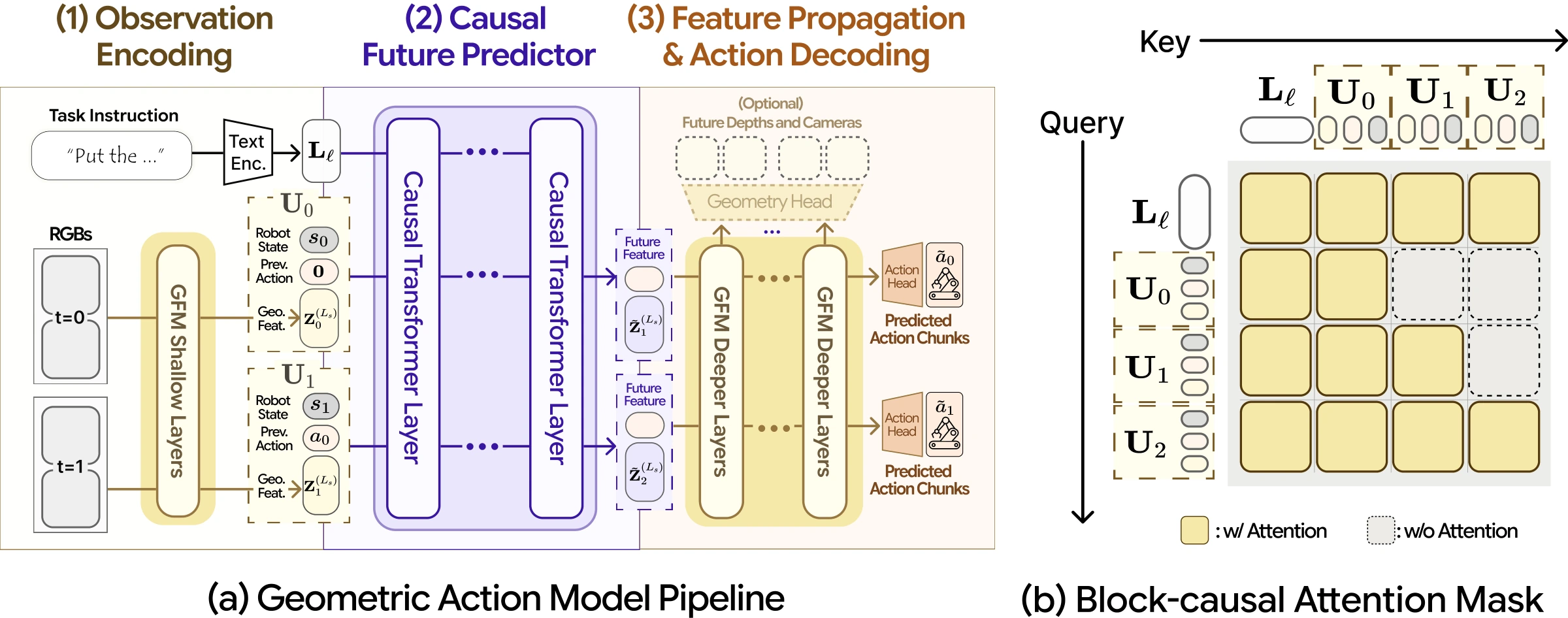
GAM cuts a pretrained GFM at an intermediate layer and inserts a causal transformer in between,
turning a static 3D perception model into a language-conditioned world-action model with minimal
architectural change, while preserving its rich geometric priors.
GAM architecture. Multi-view RGB is encoded by the GFM's shallow layers; a block-causal
transformer predicts future latent geometry from language, proprioception, and action history; the GFM's
deep layers decode the predicted tokens into future depth and executable action chunks.
1
Observation Encoding
The GFM's shallow layers are reused as the observation encoder, mapping multi-view RGB frames into
spatially meaningful latent geometric states, no task-specific encoder trained from scratch.
2
Causal Future Predictor
A causal transformer inserted at the split layer forecasts the next latent geometric state,
conditioned on the task instruction, proprioception, and action history: next-token prediction,
but for 3D world states.
3
Propagation & Decoding
Predicted future tokens flow through the remaining GFM blocks: the original depth head decodes
future geometry while a lightweight action head regresses the executable action chunk in one forward
pass, both outputs.
Why not just another VLA or world model?
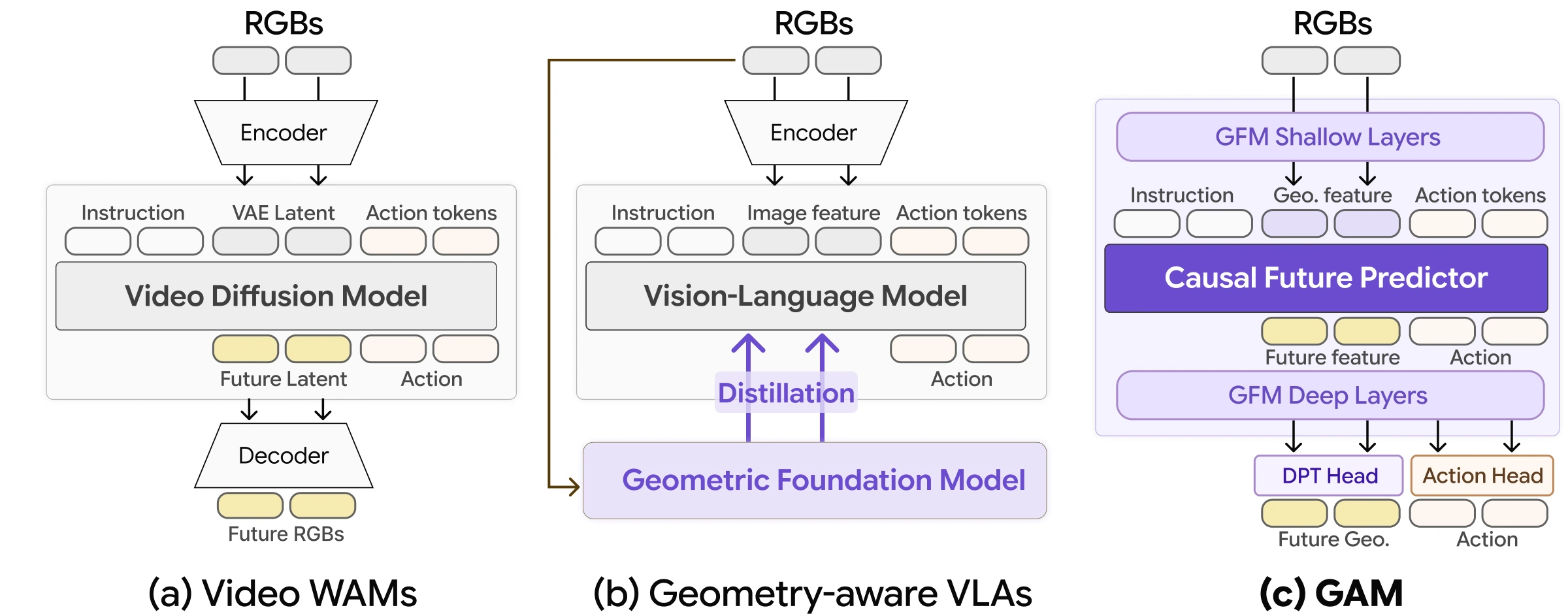
Three paradigms. GAM moves beyond 2D latents and passive feature distillation by making
the geometric model itself the policy.
(a) Video WAMs
2D pixel-space futures
Strong temporal prior from video generation
Depth, scale, and occlusion remain implicit
Diffusion-style inference is slow
(b) Geometry-aware VLAs
Geometry as a side signal
Injects geometric features into a VLA policy
Uses the GFM mostly as a passive feature extractor
Does not make the GFM's layered geometry the policy substrate
(c) GAM (ours)
The GFM is the policy
Preserves rich 3D geometric priors for policy learning
Grounds action decoding in explicit future geometry
Runs perception, prediction, and action in one forward pass
Simulation Results
State-of-the-art robustness with lower inference cost
On LIBERO, GAM matches saturated state-of-the-art success rates. On LIBERO-Plus, which perturbs
cameras, lighting, backgrounds, and layouts, it takes the overall lead, with the smallest degradation
of any method and a +9.7%p margin in the camera-perturbation split.
Method
Size
LIBERO ↑
LIBERO-Plus ↑
Camera ↑
π0.5
3.3B
96.9
84.6 (↓12.3)
72.0
OpenVLA-OFT
7B
97.1
69.6 (↓27.5)
56.4
π0
3.3B
91.3
69.3 (↓22.0)
61.0
Cosmos-Policy
2B
98.5
82.4 (↓16.1)
73.4
Fast-WAM
6B
97.6
50.0 (↓47.5)
16.4
π0.5 + Spatial Forcing
3.3B
94.0
25.7 (↓58.3)
0.1
π0.5 + ROCKET
3.3B
95.3
47.5 (↓46.6)
30.9
GAM (Ours)
1.4B
97.6
85.5(↓12.1)
83.1
Success rates (%) on LIBERO and LIBERO-Plus. "Camera" is the camera-perturbation split of LIBERO-Plus. Full tables in the paper.
Success rate vs. camera difficulty
Graceful degradation. As camera perturbations intensify (L1→L5), GAM consistently stays on top.
Single-pass inference latency
Cosmos-PolicyVideo Diffusion-based
382.4 ms
OpenVLA-OFTVLA
77.8 ms
π0.5VLA
29.2 ms
GAM (Ours)1.4B
6.9 ms · ≈145 Hz
One feed-forward pass with KV-cached history, up to 55× faster than diffusion-based policies.
SpatialObjectGoalLong
Zero-shot robustness across every perturbation factor: camera, robot, light, background,
noise, layout, and language, reported across difficulty levels on LIBERO-Plus.
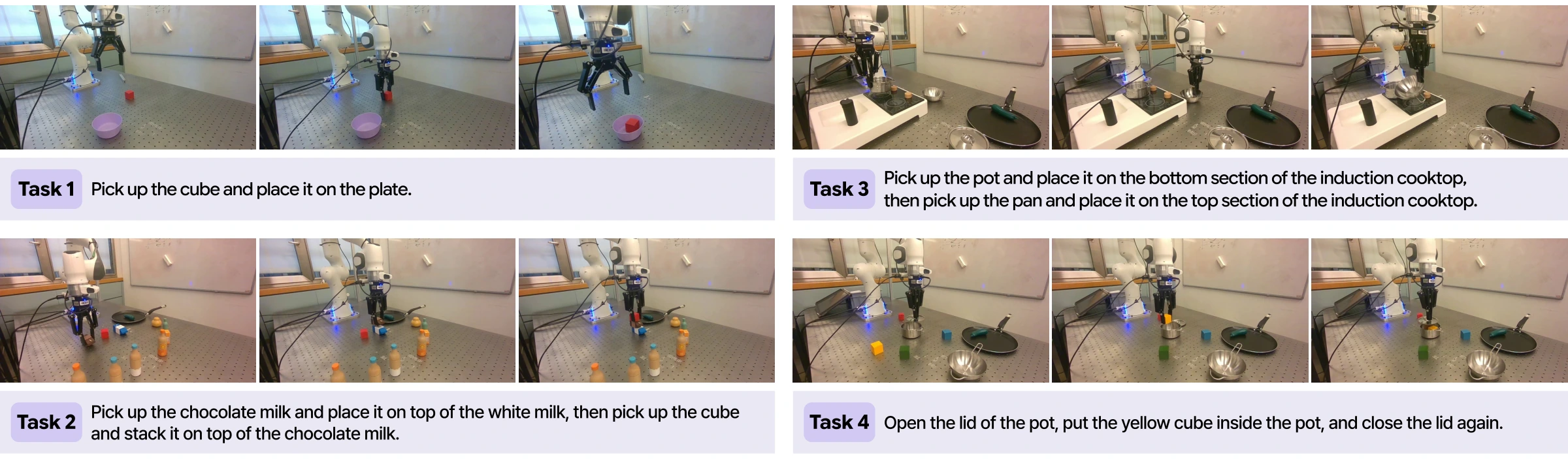
Four contact-rich manipulation tasks, trained from ~200 teleoperated demonstrations each.
Half of all evaluation trials shift the external camera by 85 cm and 45°, an out-of-distribution
setting where 2D-based policies collapse and GAM keeps working.
Real-world success rates. Light bars: in-distribution. Dark bars: camera-perturbed OOD.
GAM leads on every task in both settings.
Task suite. Pick & place · stack milk & cube · pot & pan on cooktop · insert cube into covered pot.ID vs. OOD. The external camera is translated 85 cm and rotated 45° for OOD trials.
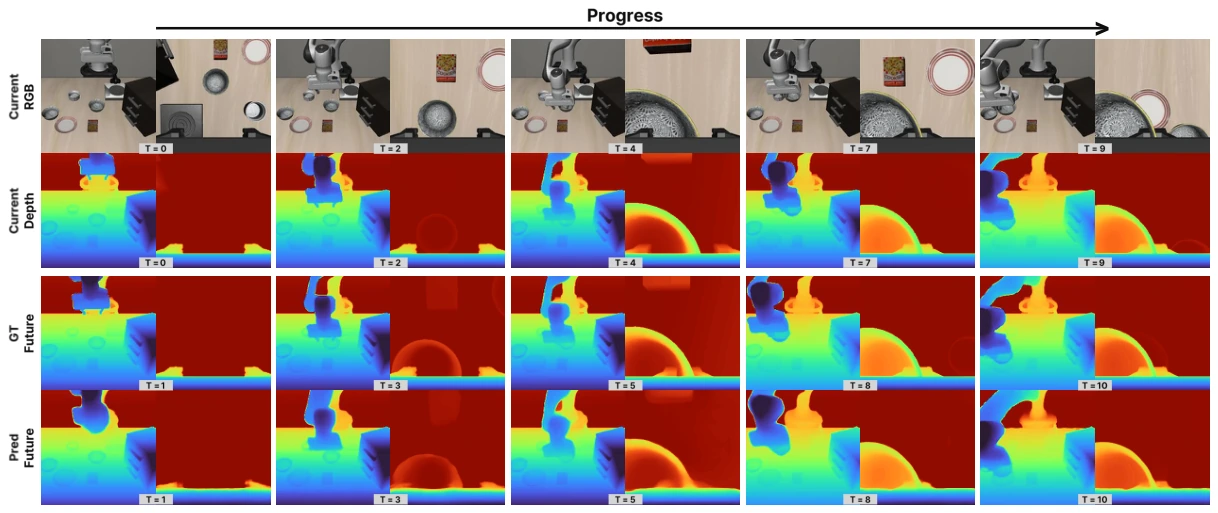
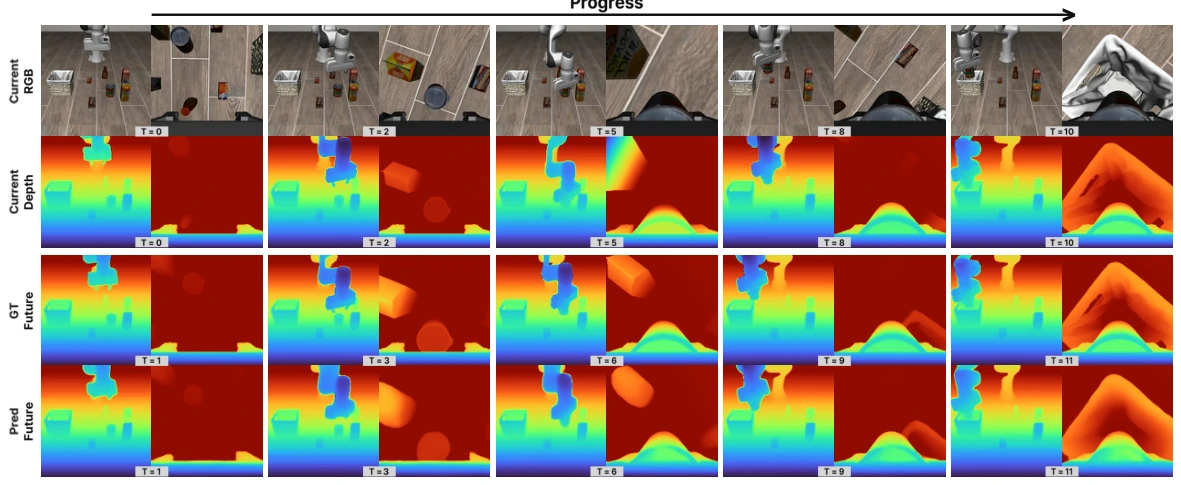
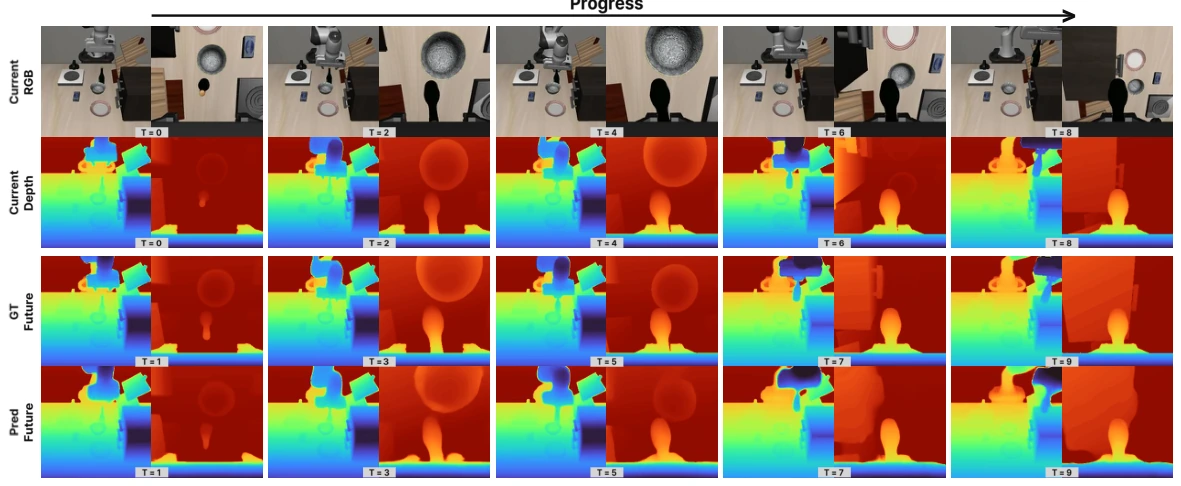
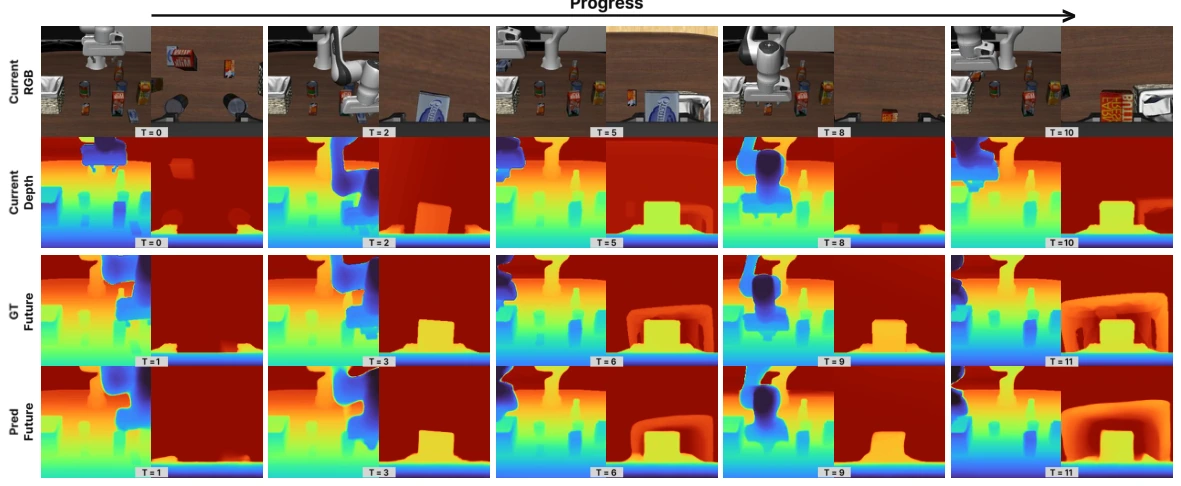
Because future prediction lives in the GFM's latent space, GAM's forecasts decode into dense future
depth maps that closely track ground truth. Swipe through rollouts from each LIBERO suite.
LIBERO-Spatial · "Move the bowl from the table center to the plate": current RGB/depth, ground-truth future, and GAM's predicted future depth over time.
LIBERO-Object · "Put the tomato sauce in the basket": predicted future depth stays aligned with the true scene evolution.
LIBERO-Long · "Put the cream cheese and butter in the basket": coherent geometric futures across a long-horizon task.
LIBERO-Goal · "Put the wine bottle on the cabinet": the same backbone that acts also predicts the 3D future.
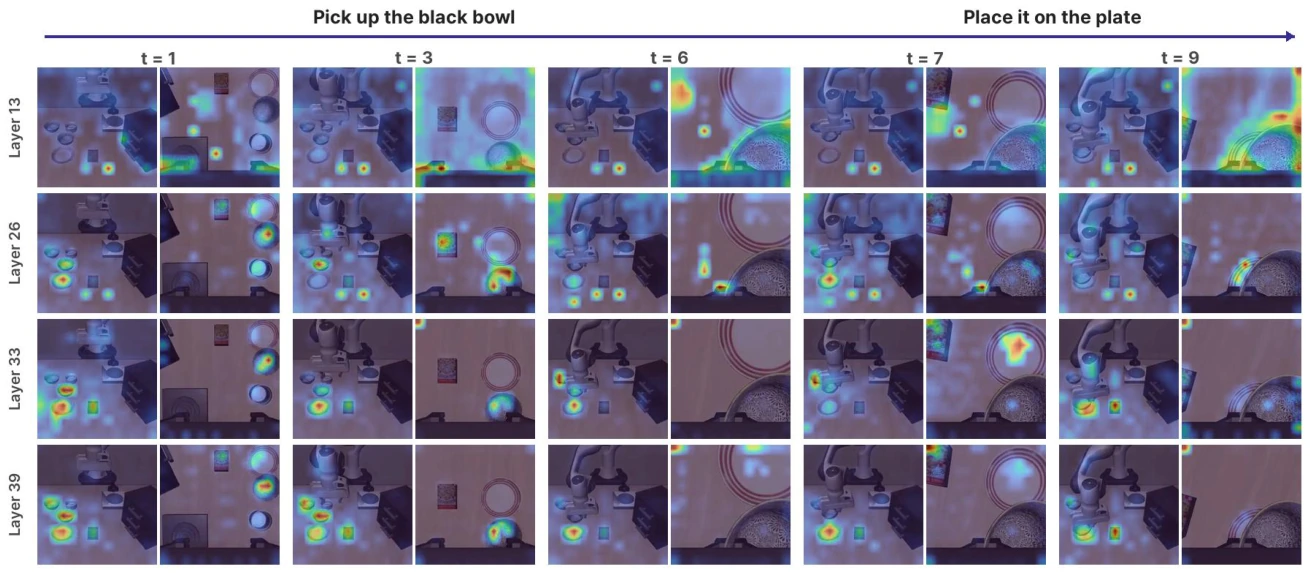
Action-token attention. Action tokens learn to attend to task-relevant objects and the end effector, geometry-grounded credit assignment for free.
Simulation Rollouts
Policy rollouts from simulation
Uncut open-loop rollouts of GAM on LIBERO Original and LIBERO-Plus. Each clip shows the external camera (left)
and the wrist camera (right). Pick a task suite and swipe through.
Training & Setup
Pretrained on 784K trajectories. Post-trained per benchmark.
GAM builds on DA3-Giant and is pretrained on a mixture of Open-X Embodiment (72%), MimicGen (18%),
and RoboCasa365 (10%) single-arm robot data, then fine-tuned on each benchmark with future-depth
supervision from simulators or teacher pseudo-depth.
Pretraining mixture. High-level source mixture (left) and the share of each constituent
dataset relative to the entire training corpus (right).
Citation
BibTeX
@misc{han2026geometricactionmodelrobot,
      title={Geometric Action Model for Robot Policy Learning},
      author={Jisang Han and Seonghu Jeon and Jaewoo Jung and Ren{\'e} Zurbr{\"u}gg and Honggyu An and Tifanny Portela and Marco Hutter and Marc Pollefeys and Seungryong Kim and Sunghwan Hong},
      year={2026},
      eprint={2606.17046},
      archivePrefix={arXiv},
      primaryClass={cs.RO},
      url={https://arxiv.org/abs/2606.17046},
}

 Hugging Face